
In late April, discrepancies were discovered in the reported ballot totals for two precincts, one in Pinehurst and another in Carthage, from the March Board of Education primary election.
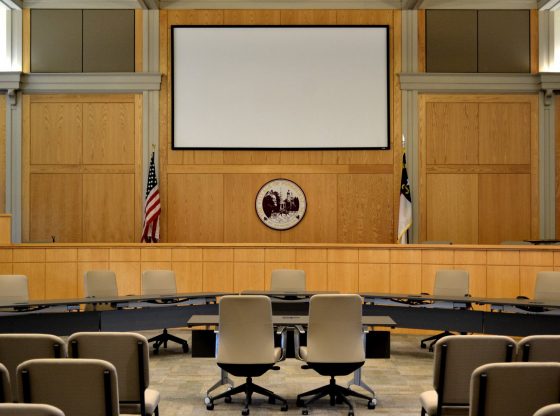
Subsequently, the Moore County Board of Elections held a public meeting to explain the issue and outline steps to prevent such discrepancies in future elections.
The issue was brought to the public eye shortly after a Moore County resident noticed an error while reviewing the data on his own.
“I am thankful that the board has looked into the data that I shared just with some of the concerns that I noticed when I was going through the report beforehand,” said Josh Lowry, the West End resident who noticed and reported the discrepancies. “I’m just glad that you guys have listened to it and are looking into better ways to prevent things like this from happening, [but] I’m also glad that there are people like myself who just double-check things too on our own time.”
Lowry explained that this is a pastime for him and that he never expected his findings would impact or potentially help the community.
While reviewing election data for his personal interest, Lowry identified a discrepancy in the data. When analyzing the data, he noticed unexpected vote distributions in the school board race between two precincts: Carthage and Pinehurst B2. Specifically, a candidate received an unusually high number of votes in Pinehurst B2 and fewer than expected in Carthage, their home precinct. This prompted further investigation.
Board of Elections Chair Robert Howell was the first member of the board to directly speak on the findings. “Checks and balances [are] needed to prevent the error made during the first primary election back in March and to better ensure election data integrity,” said Howell. However, he defended the Board of Elections, stating, “As an ordinary mortal, the error wasn’t as glaring an error as some have described.”
According to Howell, the mistake was an easy one to make. “The system is fairly complex; the machines, the paperwork, the processes, the technology that support it in order to safeguard the integrity of our elections is rather involved,” he explained.
Director Towanna Dixon followed Howell to explain what, by her account, happened. According to Dixon, the issue stemmed from a mix-up of “media sticks,” otherwise known as flash drives, used to record and upload the vote totals. The results for Carthage were recorded on the drive labeled for Pinehurst B2 and vice versa. This mislabeling caused the data to be reported incorrectly.
Dixon confirmed that during setup, officials are supposed to ensure that the flash drive matches the voting machine’s label and that the machine reads zeros and displays the correct precinct when turned on. This check was overlooked in this instance.
A courier also handles the flash drives prior to their arrival at the Board of Elections.
Despite these safeguards, the incorrect assignment of the flash drives to the precincts went unnoticed, which Dixon states is due to a rush to provide timely results. “We got everybody wanting the numbers. It wasn’t caught; it wasn’t checked at that time,” she said in defense of the Board of Elections.
Once the problem was pointed out, the Board contacted the State Board of Elections. However, since the election had already been finalized, no immediate corrective action could be taken. They confirmed that the discrepancy did not affect the outcome of the race.
In response, the team reviewed their procedures, ensured the accurate comparison of data with physical tapes, and confirmed that the correct numbers were recorded and valid but attributed to the wrong precincts.
The Board personally assured the public that, moving forward, they will do their best to ensure that every voting machine is properly labeled and that those who handle the equipment are properly trained.
After the issues with the election results were sufficiently explained, the Board moved on to the next agenda item: ideas for streamlining drop-off of absentee ballots by authorized individuals at early voting sites for the general election.
During previous discussions about early voting plans for November, concerns were raised about the limited number of voting sites and potentially long lines.
One proposed solution involves designating a specific station at each early voting site for the return of absentee ballots. The goal is to allow those returning absentee ballots to bypass the regular voting line and lengthy voting processes.
Previously, this logging was done on computers, but it has shifted to a hard copy log, which is then scanned and entered into the system back at the main office. Dixon believes this process can be streamlined and made easier for absentee voters and election officials.
“If they’re bringing back somebody else’s stuff, they got to sit and log it in, and then we try to do everything with them right there to help,” said Dixon.
However, Dixon also believes many processes involving voters — especially absentee voters — can be chaotic. She recounted that when previously working in Hoke County, voters often “take offense” when they believe other voters are allowed to “cut in line” when they’re dropping off an absentee ballot. Often, election officials have to explain that voting can be done curbside to save time and avoid lines. At Hoke County election sites where she previously worked, this often resulted in yelling and angry voters.
Board member Martin Carpenter concurred that absentee voting can be chaotic. “Most of the people I’ve talked to that actually went and got absentee ballots change their mind. They just don’t bring it in; they just come in to vote,” he noted.
Dixon vocalized a similar sentiment. “Especially military is really bad; you have some military that will get an absentee because they think they’re going to be gone or that they’ve cheated because with military it’s a same-day registration,” said Dixon. “With the military ballot, they missed the deadline, and they’ll use that to register.”
Moving forward, the Board of Elections hopes to make progress on the following: having dedicated help desks for absentee ballots, curbside voting management, having adequate help desks, physical expansion, and more staffing and equipment.
“We are doing everything we can to make sure that everybody who wants to vote can vote,” stated Howell. “I don’t want to sound dismissive about this, but there’s not a guarantee that you won’t have to wait in line. We do all that we can’t to minimize that, and the reason is [because] inconvenience can dissuade people from voting.”
~Written by Sandhills Sentinel assistant editor Abegail Murphy.