
The Carthage Planning Board voted unanimously Thursday to recommend rezoning a 134-acre property north of U.S. 15-501 and west of Priest Hill Road for a mixed-use development expected to unfold over the next decade.
The decision, however, didn’t come without at-length discussion from board members, developers, and residents alike.
The Plan and Presentation
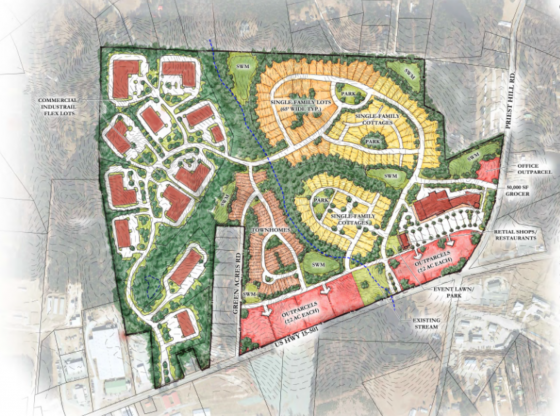
The proposal, known as Priest Hill, includes a combination of housing, flex industrial space, and neighborhood-scale retail along U.S. 15-501 and Green Acres Road. The project could ultimately include up to 250 homes under conditions adopted by the board, along with commercial and employment space.
The development is being proposed by Rhetson Capital, represented at the meeting by Matt Taggart, with design work by KoontzJones Design +V3.
During a presentation that outlined the project’s goals, Taggart said the concept was developed after discussions with town officials and economic development representatives about Carthage’s needs. The Moore County Economic Development Partnership (MCEDP) was also consulted regarding the needs of the greater Moore County area.
“We approached this with a longer-term vision that gives balance and responsible growth,” Taggart told the board. “It’s about creating jobs, bringing new community members, and providing convenient services in one cohesive development.”
The proposal includes flex space intended for small and mid-sized businesses, which Tagger said is in high demand in Moore County. Through conversations with the MCEDP, developers found that demand for such space has increased about 75% in recent years, but there are few locations in the county offering it. By adding these units, developers hope small businesses and local entrepreneurs will be able to utilize the space.
Plans also call for a neighborhood retail center intended to provide everyday services so residents do not have to leave town for basic needs, including a 40,000 square-foot grocery store.
Environmental features such as wetlands, streams, and existing ponds would remain protected, with portions of the natural landscape used as buffers between development areas. At least 10% of the property, or about 13 acres, would be reserved as open space.
Sidewalks would be installed on one side of streets throughout the development, and landscaping would rely on native plants rather than irrigated turf to reduce water demand.
The development would be done slowly over 10 to 15 years, and Carthage officials would be consulted on the implementation of each phase: industrial, retail, and residential.
A Deeper Look and Debate
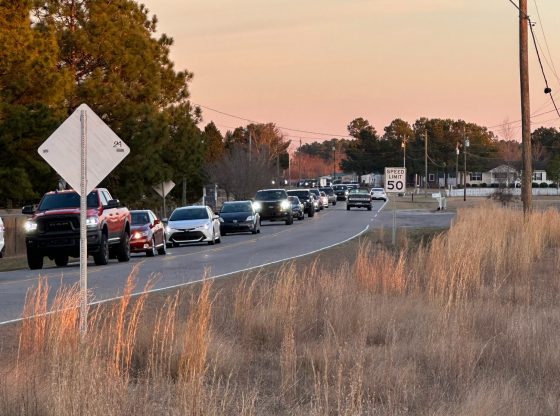
Several planning board members questioned how the project could affect traffic and public utilities.
Board member Corey Deibel said the traffic impact analysis, completed in December 2025, did not account for seasonal agricultural traffic on the roadway. Deibel is a staunch supporter of Carthage’s agricultural background, and though he appreciated that school traffic was accounted for, he hopes to see a study that takes “grain trucks and combines” into account.
“If you look from Fayetteville to Raleigh, that section hasn’t stopped being built since 1998,” added Deibel, “and we don’t want to see that here.”
Board members also expressed concern about traffic near the Moore County Fairgrounds and the timing of a potential traffic signal at Priest Hill Road.
Bob Koontz, a planner on the project team, said road improvements would be coordinated with the N.C. Department of Transportation (NCDOT) as the project moves through its phases.
Proposed improvements include turn lanes, widening portions of U.S. 15-501, and potentially installing a traffic signal at Priest Hill when warranted. Koontz said those upgrades would be funded by the developer, and that neither the Town of Carthage nor the NCDOT would have to provide any monetary contributions for the work.
Questions were also raised about water and sewer capacity.
Planning board member Victoria Riddle, though supportive, noted that other developments have been delayed or cancelled because of limited infrastructure. However, she made it clear that she understood the meeting was purely for the rezoning of the property and that she only wanted developers to know there may be potential infrastructure-related setbacks later in the project.
“This is just for the zoning,” Riddle said. “We don’t currently have the ability, in terms of infrastructure, to build anything like this right now.”
Board member Ian Lumgair asked, “Is the Town of Carthage planning on finding more water?”
Carthage Management Analyst Jamie Sandoval, however, said that Carthage is in fact working to expand water capacity, and Taggart clarified that the project’s phased approach would allow time for utilities and permits to be secured.
Board member John Ferrari criticized the traffic study, saying the projections appeared lower than what the development could eventually generate, and repeatedly criticized the numbers and graphics given in the presentation. He cited his time spent in similar fields in Massachusetts, that he “doesn’t think Carthage is any less sophisticated,” and that “this would never be allowed up there.”
Taggart and Koontz both explained that there is currently no solid number to work with, since the design given is only an approximation of the plan. The vision will likely be changed several times based on feedback from the town’s boards and what is deemed feasible.
Lifelong Carthage resident Priscilla Riley, whose family had owned part of the selected parcel for generations, spoke up during the public comments period.
“We’ve kept it agriculture and timber because we never saw a plan that was good not just for the people who would live there, but for the town. This group showed us businesses, parks, walkways, and lots of amenities that would apply not just to the people who would live there, but to the whole town,” said Riley. “We have lived here forever; as long as I’ve been on this earth, I’ve been in Carthage. We feel that this plan will help the community.”
“This is a pretty picture that means nothing,” Ferrari told her regarding the design put forth in the presentation.
Moving past this, the board also considered the greater impacts on Moore County; though the development would be convenient, it would add more children to the school system and potentially strain resources. Board members questioned whether the new Carthage Elementary would be large enough to accommodate an influx of students.
Lumgair pointed out that there were no school board officials or county commissioners in attendance, despite ongoing discussions about school growth and infrastructure needs, and that a project of this scale is important.
Conditions and Votes
Despite the in-depth conversations and critiques, developers maintained that the purpose of the meeting was for a rezoning request and that they are more than agreeable to having conditions put in place or altering future plans. Koontz reiterated that the photos shown were only rudimentary, preliminary designs and that the project is apt to be changed and brought back to the board throughout every phase over the next 10 to 15 years.
Before voting, the developers agreed to all suggested conditions, including reducing the maximum number of homes from a potential 400 units to 250 and adding a 50-foot buffer along a portion of the property.
The board first voted unanimously that the planned unit development rezoning was consistent with the town’s land-use plan. Members then unanimously approved recommending the rezoning with the additional conditions.
The proposal will next move to the Carthage Board of Commissioners for consideration.
Feature photo via Town of Carthage.
Abegail Murphy | Assistant Editor
Written by Sandhills Sentinel assistant editor Abegail Murphy. Abegail has been writing for Sandhills Sentinel since 2021.
Want Moore news that matters? Please click here to sign up for the free Sandhills Sentinel e-newsletter.
Follow Sandhills Sentinel: Facebook | X | Instagram | YouTube | TikTok | Threads | Newsletter