

The Sandhills Metropolitan Planning Organization (SMPO) met Wednesday to review regional traffic safety data, discuss upcoming transportation projects, and move forward on several planning items during its Feb. 4 meeting. The meeting included a presentation from the N.C. Department of Transportation and discussions of long-range planning efforts.
Crash Trends and Safety Numbers
Brian Murphy, a traffic safety engineer with NCDOT, presented crash and safety data covering the SMPO planning area and statewide trends.
During his presentation, Murphy said population growth and increased vehicle travel continue to affect crash numbers. North Carolina added about 1 million residents over the past decade, while the SMPO area added roughly 10,000 people during that same period.
North Carolina sees more than 300,000 reported crashes each year, Murphy said, while the SMPO area averages about 2,000 crashes annually. Fatalities remain a major concern. The state records roughly 1,700 to 1,800 traffic deaths per year, while the SMPO area typically sees between five and 15.
Serious injury crashes average about 5,000 per year statewide, with 25 to 30 occurring annually within the SMPO boundary. Murphy noted, however, that changes to how serious injuries are classified affect long-term comparisons.
Vehicle miles traveled, a measure of roadway activity, dropped sharply in 2020 during the COVID-19 pandemic but has since rebounded to near or above pre-pandemic levels, and crash totals followed a similar pattern.
Murphy pointed to three primary behavioral factors contributing to fatal crashes in the state:
Seatbelts: Unbelted occupants account for approximately 20% of fatalities and serious injuries.
Alcohol: Impairment is involved in about 15% of severe crashes.
Speed: Speeding contributes to roughly 15% of fatalities.
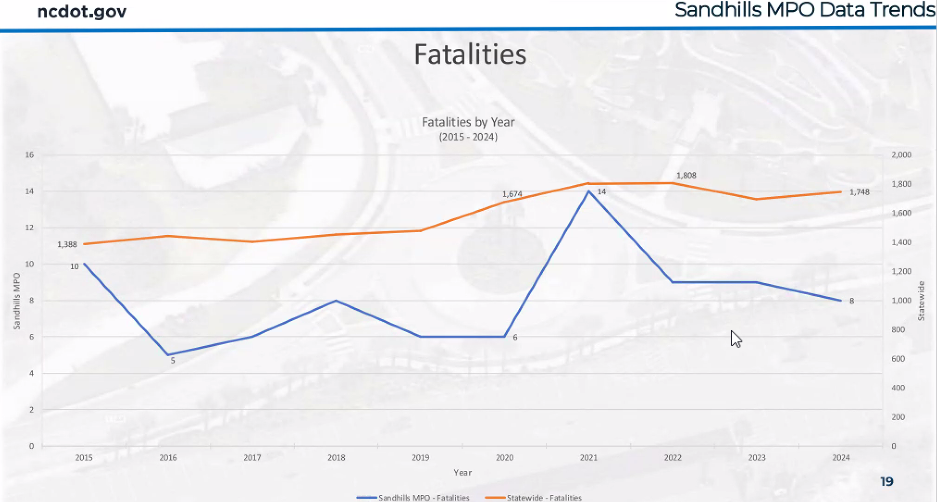
Via Sandhills Metropolitan Planning Organization.
Pedestrian and bicycle crashes also continue to trend upward statewide, particularly in urbanized areas. The SMPO area records between one and six non-motorized fatalities or serious injuries each year.
“The goal that we’re currently operating under is to reduce all fatalities and serious injuries by half by 2035, moving towards zero by 2050,” explained Murphy. “So, we know our past performance. We know we want to be half of that by 2035, based on our stated goal, so we can do the math to determine where we need to be each year if we’re making steady progress toward that goal.”
Federal law requires states and MPOs to track five safety performance measures, including the number and rate of fatalities and serious injuries. Targets use five-year rolling averages.
The committee voted to recommend the SMPO governing board adopt the state’s safety targets, which aim to reduce fatalities and serious injuries by 50% by 2035. However, Murphy confirmed that the state did not meet or make significant progress toward these goals in the most recent federal assessment.
SMPO Director Scott Walston reiterated that, because local datasets are small, often involving single-digit fatality counts, it is statistically difficult for the MPO to set independent targets.
Prioritizing Regional Projects
The board spent considerable time discussing transportation project prioritization, a process required under North Carolina’s Strategic Transportation Investments law.
The board reviewed a draft methodology for ranking projects competing for regional and division-level funding. The approach combines quantitative data—such as safety scores and connectivity—with qualitative measures, including consistency with adopted plans and multimodal support.
Walston presented a draft system that would give the SMPO points to allocate toward priority projects. The proposed scoring criteria include:
Safety Score: Based on crash data and safety benefits.
Connectivity: How well the project connects to the existing system.
Plan Consistency: Projects receive more points if they appear in existing local plans, such as the Comprehensive Transportation Plan.
Multimodal Support: Points awarded for projects that support transit, bicycle, or pedestrian travel.
The group discussed how to handle projects that cross MPO boundaries, such as improvements to the U.S. 1 corridor. The proposed methodology allows the MPO to prorate points based on the percentage of the project located within its jurisdiction. For example, if only 25% of a project lies within the SMPO, it might only be eligible for 25 points, allowing the remaining points to be used elsewhere.
The committee also considered splitting the point allocation between highway and non-highway projects to ensure bicycle and pedestrian improvements receive funding consideration. No decision was made, and members agreed to revisit the issue before final adoption, which is expected later this spring.
“We’re going to get a list of projects, and we’re going to need to figure out how we’re going to prioritize these,” encouraged Walston.
Population Trends
In other business, the committee voted to stand by their own population growth estimates for the travel demand model, despite new figures from the Office of State Budget and Management suggesting slower growth.
According to a report reviewed by the board, the state demographer’s office recently lowered its 2055 population projections for the area. However, committee members argued that local data regarding housing developments and employment centers offers a more accurate picture for long-term transportation planning in the Sandhills.
Feature photo contributed.
Abegail Murphy | Assistant Editor
Article by Sandhills Sentinel assistant editor Abegail Murphy. Abegail has been writing for Sandhills Sentinel since 2021.
Want Moore news that matters? Please click here to sign up for the free Sandhills Sentinel e-newsletter.
Follow Sandhills Sentinel: Facebook | X | Instagram | YouTube | TikTok | Threads | Newsletter