
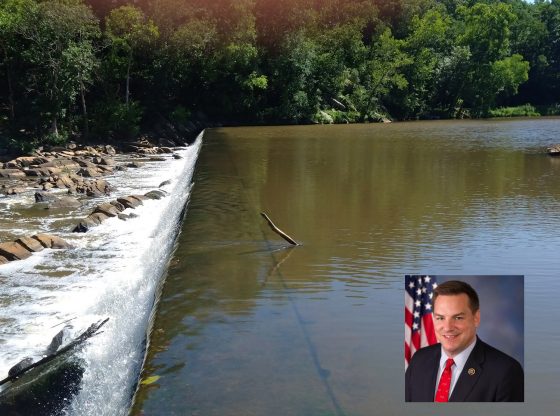
U.S. Rep. Richard Hudson called on the U.S. Fish & Wildlife Service (USFWS) to stop the proposed removal of the High Falls Dam in Moore County. In a letter sent Oct. 23 to USFWS Director Brian Nesvik, Hudson warned that dismantling the historic structure would devastate one of the most ecologically unique sections of the Deep River and ignore the will of the local community.
“The High Falls Dam has played a vital role in the Moore County community for hundreds of years, and its impending removal poses a significant threat to countless local species of fish and wildlife,” said Hudson in a press release. “Removal of the dam would unleash years of accumulated sediment downstream, suffocating spawning grounds and permanently destroying what remains of their limited habitat.”
Hudson also emphasized that the reservoir supports a “rich community of migratory and semi-aquatic species — including Osprey, Great Blue Heron, Hooded Merganser, River Otter, and American Beaver — all of which rely on the High Falls impoundment for food, nesting, and denning.”
He warned that “by removing the dam, we would be replacing a stable, thriving habitat with an unpredictable, degraded ecosystem where these species cannot survive.”
Hudson’s letter further notes that the plan is “heavily backed by the Southern Environmental Law Center, which has a long track record of ignoring science and the negative impact dam removals have on local species of fish and wildlife.”
He continued, “They are an outside organization with no ties to the local area, and in a short period of time will begin deconstruction on the dam despite universal condemnation from the local community. To put it simply, this plan comes at the direct expense of local fish and wildlife, public safety, water security, and the expressed will of the local community.”
“For these reasons, I respectfully urge you to prevent the current dam removal,” Hudson concluded. “Protecting the High Falls ecosystem means protecting one of the last remaining refuges for multiple endangered species in the Cape Fear River Basin.”
More than 2,200 residents have signed a petition opposing the dam’s removal. Hudson wrote that “local leaders from both parties have unanimously voiced their opposition to the plan, and the community is united in its desire to preserve this historic structure.”
The Moore County Board of Commissioners voted on July 15 to oppose the proposed removal of the High Falls Dam.
Regarding the removal of the dam, which the commissioners have been fighting since 2023, the board voted unanimously to send a letter to Hudson formally opposing the proposed removal of the dam.
During that meeting, commissioners outlined several major concerns with the project, which was under conditional approval by the Federal Energy Regulatory Commission. The board’s letter cited three primary objections: the Deep River’s potential as a future water source for Moore County, current plans for the High Falls Fire Department to use water from the impoundment area to fill trucks, and removal of the impoundment area may adversely impact well-water availability of residents and property owners along the river.
During a 2023 presentation by Unique Places to Save, American Rivers, and Resource Environmental Solutions (RES), citizens of Northern Moore County expressed concerns about the possible removal of the dam.
During the presentation, Peter Raabe of American Rivers presented why Deep River would be more beneficial without the dam and the reasons behind removing it. Raabe discussed the dirt building behind the dam, fish species, vegetation, and the liability for the landowner. The Deep River is the home of the Cape Fear minnow and the elktoe mussel. He also discussed the condition of the dam that was initially built in the late 1800s, and it was modified in the 1920s to generate hydroelectricity for Hydrodyne Industries.
“The dam owner has a liability,” said Raabe. “They have to address that liability, and so there’s a question of how do you do that. Do you do that by fencing off the property, keeping everybody out, making it completely private, and not allowing any access to the river? Or you remove the liability and create an asset for the community by creating a space that people want to go and people want to congregate right on the river. And one that is part of day-to-day life.”
For Moore news delivered straight to your inbox, please click here to sign up for the free Sandhills Sentinel e-newsletter.