

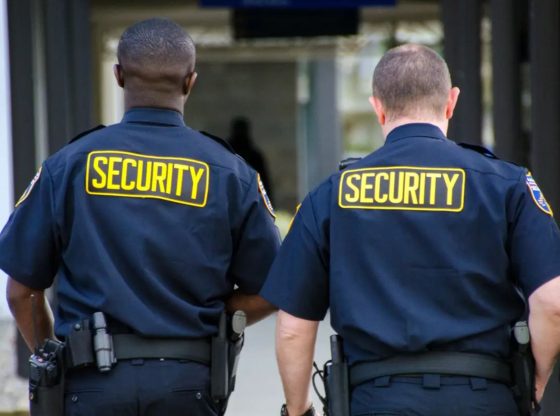
The Moore County Board of Education’s Temporary Safety Committee met Monday to continue discussions on strengthening school safety. Having previously withdrawn a proposal to place private unarmed security in schools, the Safety Committee is now exploring partnerships with local law enforcement agencies and creating a strategy to combat staffing shortages.
Board Chair Dr. Robin Calcutt opened the meeting by thanking committee members for their experience and commitment to improving safety across Moore County Schools. She said the committee was created to bring diverse perspectives together and build on the district’s existing safety program.
The committee is comprised of board members Ken Benway, Robin Calcutt, and Shannon Davis, along with Staff Liaison Jamie Synan and Superintendent Dr. Tim Locklair. Moore County Sheriff’s Office Chief Deputy Andy Conway and Moore County Schools Police Chief Ricky Gooch were invited to share their insights at the meeting as well.
“We’re all very different, we have unique perspectives,” said Calcutt. “I want to recognize the value of each one of you. This team was pulled together because of who you are and your knowledge and your experience.”
Staffing and Recruitment Challenges
Locklair said the district continues to face challenges recruiting school resource officers, a difficulty that has persisted since the expansion of the Moore County Schools Police Department (MCSPD) was approved in 2022.
In 2010, the MCSPD became a designated campus police department—only the second in North Carolina to earn this status. Until 2022, the department included 13 School Resource Officers (SROs) and one Police Chief. That year, county commissioners approved 13 additional positions, ensuring every school in the district could have a dedicated officer.
Officers complete rigorous law enforcement and school-specific certifications, with ongoing training in firearms, emergency response, de-escalation, and active shooter scenarios. Many also hold specialized instructor credentials, ensuring the team is equipped to protect students and staff across every campus.
By state law, school officers must have at least one year of prior law enforcement experience and in-state certification before being hired. Calcutt said that requirement limits the hiring pool, especially as North Carolina continues to see population growth from out-of-state residents.
Synan admitted that the district’s police force is highly qualified but underpaid compared to surrounding agencies. MCS School Police Officers’ yearly salary range is $40,388.89 – 65,325.72, while local law enforcement agencies report salaries ranging from $42,500 – 85,792.
Benway, however, recalled that the county commissioners previously allotted money for SROs and would like the board to take a closer look at its financial situation to see if the hiring of SROs could be more financially feasible than previously believed.
Exploring Off-Duty Support
The committee discussed the potential of hiring off-duty municipal officers to help provide coverage.
“It’s possible for a short-term fix,” Conway said, “but I don’t know of it being a long-term solution.”
Synan reported that the district reached out to area police departments and the Sheriff’s Office to gauge interest. Most agencies charge about $55 per hour for off-duty work, but Conway noted that state rules limit off-duty law enforcement assignments to 20 hours per week for no more than 12 weeks.
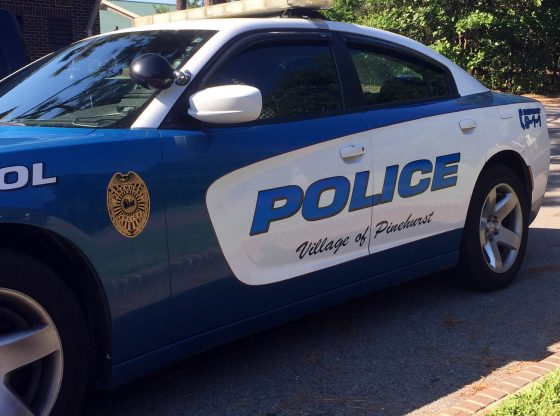
Locklair maintained that cost remains a hurdle. Of the municipality police departments willing to provide coverage, the Village of Pinehurst, Southern Pines, Whispering Pines, and Pinebluff police departments quoted $55 an hour. The Village of Foxfire Police Department quoted $50 an hour, and the Aberdeen Police Department quoted $70. The Carthage and Robbins police departments would not be able to assist due to staffing demands.
Synan estimated that, in a quick calculation, it would cost roughly $1.1 million annually to cover all schools with off-duty officers.
Pay, Benefits, Retention, and Relationships
The committee also reviewed benefits for officers, including separation/retirement allowances. According to Locklair, current policy indicates that retiring SROs receive half their benefits if they retire at 10 years, and only receive the full amount at the twenty-year mark.
Locklair believes that lowering the number from twenty to 10 may make the job more appealing and help significantly with recruitment.
“We’re looking at that, and we have to be aware of the budgetary liability,” Locklair said. “That 10-year mark is something I may recommend to the budget committee next week.”
Conway pointed out that half the district’s current officers are retirees who would not qualify for the allowance a second time, so the school system wouldn’t have to worry about paying retirement benefits to those officers anyway.
Furthermore, by having on-staff, permanent SROs, the officers are able to form bonds with students and staff at their assigned school. Throughout the meeting, board members reiterated the importance of consistent, relationship-based policing in schools.
Calcutt said familiarity and communication between officers, students, and administrators make schools safer. “It’s hard to put it into words sometimes,” said Calcutt, “but when you know your community, when you know the people in it, you know their families, you can recognize when someone needs a little more help that day.”
Gooch added that consistency matters. “The current officers would have a fit if I moved them from one school to another,” he laughed. “They’re part of [the school], they know those kids.”
Benway, meanwhile, called for an updated threat assessment and a coordinated safety strategy that includes all levels of government. He provided fellow board members with a document he prepared delineating his ideas.
“We’ve got an urgent need to protect our schools,” he said in support of his whole-of-government approach. “Thirteen schools in Moore County lack dedicated, on-site armed security with no relief in sight. Current N.C. legislation does not facilitate school security.”
Deputy Conway Proposes Possible Solution
Toward the end of the meeting, Conway proposed a solution that piqued the board’s interest: modeling a “cadet program.”
According to Conway, the Moore County Sheriff’s Office Cadet Program was created to address staffing shortages by sponsoring select employees through Basic Law Enforcement Training (BLET) at Sandhills Community College using lapse salary funds. This was developed out of necessity to address staffing shortages and ensure a steady pipeline of qualified law enforcement officers.
“Candidates are chosen through a competitive selection process to ensure that only the most motivated and qualified employees are given the opportunity to advance,” explained Conway in a statement made to Sandhills Sentinel. “Following that initial success, we recognized the value of maintaining this approach as a long-term recruitment and retention strategy.”
He said such a program could target more experienced candidates, including military veterans—a population that has been vocal about its willingness to protect Moore County students.
Conway said that over the past two years, the program has continued to thrive. The success of the Cadet Program is a direct result of the proactive steps taken to address workforce challenges within the Sheriff’s Office.
“This model could also serve as the framework for Moore County School Police seeking to build their own internal training pipelines,” Conway said. “Depending on clarification regarding the ‘one-year rule’ related to prior sworn service for School Resource Officers, they could potentially utilize lapse salary funds, as Dr. Locklair described as being available from previous years of vacancies. Use those funds to hire cadets, sponsor them through BLET, and place them in field training assignments upon completion for approximately six months. After one year, their cadets could transition into full-time roles as certified School Resource Officers, ready to serve in local schools.”
In doing so, officers with a specific interest in protecting schools and becoming SROs would effectively be put on a pipeline to the job of their choosing.
Calcutt asked if staff could meet with Conway to review the program details. Conway agreed, adding that it took several semesters for the Sheriff’s Office to refine its system.
The Conclusion
Calcutt concluded the meeting by thanking members for their ideas and collaboration, and for Conway for bringing a possible solution to the table. She asked staff to continue meeting with law enforcement partners and to bring updates back to the committee soon.
“Our Moore County Schools police officers are so important to us,” Calcutt said. “You’re working with children, and this is the best way to keep them safe.”
Want Moore news that matters? Please click here to sign up for the free Sandhills Sentinel e-newsletter.
~ Written by Sandhills Sentinel Assistant Editor Abegail Murphy. Abegail has been writing for Sandhills Sentinel since 2021.
Feature photo from Canva.










Comments
Comments are closed.