
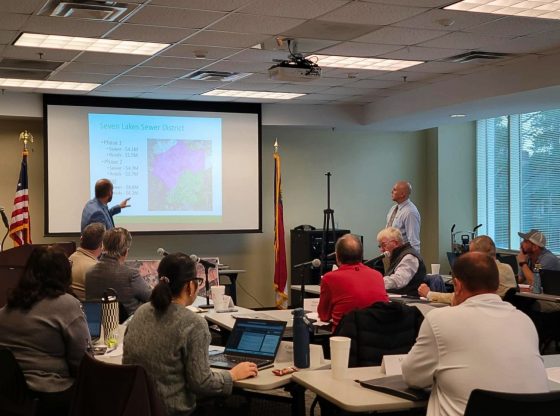
At a meeting held by the Moore County Board of Commissioners on Jan. 14, the commissioners and local representatives had the chance to have their voices heard by Senator Tom McInnis. During the meeting, county officials presented an agenda to fix infrastructure and secure long-term water independence for the county.
The meeting, held at the Rick Rhyne Public Safety Center, served as a platform for the Moore County Board of Commissioners to request specific local bills and funding matches that would allow the county to bypass traditional regulatory hurdles.
Seven Lakes: A “Common Sense” Fix for Roads and Sewer
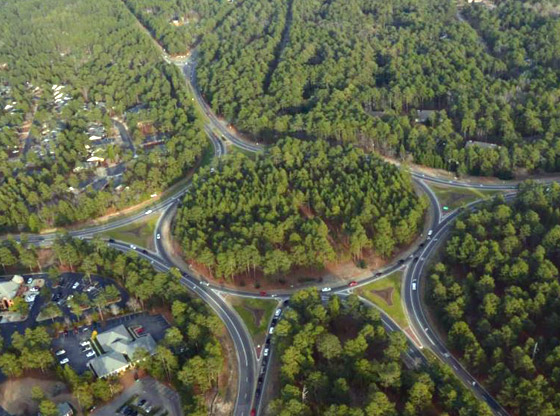
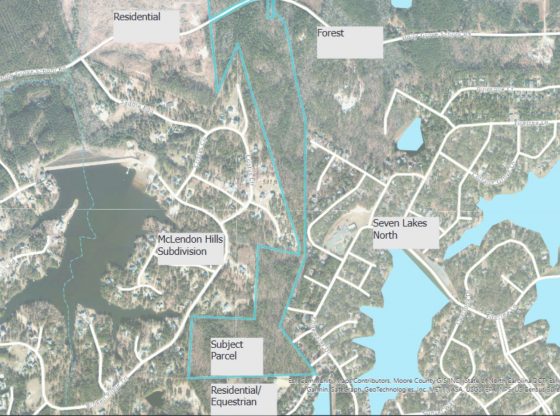
The board is moving forward with a major sewer expansion in the Seven Lakes business district, backed by $15 million in funding already secured from the General Assembly.
However, a legal obstacle remains: the roads in the district are privately owned by an entity with no ability to raise revenue for repairs.
County Manager Wayne Vest explained that while the county is authorized to build sewer systems, it is not currently permitted to perform the necessary road work. “While we’re looking at developing a collection system, we’d also take the opportunity to bring the roads up to DOT standards,” Vest proposed.
Commissioner Nick Picerno noted the absurdity of tearing up the “absolutely horrible” roads for sewer lines without fixing the pavement simultaneously.
“Common sense says let’s fix the problem once and for all instead of going in time and time again,” Picerno said, “and our board is driven by common sense.”
McInnis agreed to sponsor a local bill that would allow the county to take over these roads, bring them into compliance with state specifications, and establish a special tax district to recoup costs from local property owners over time.
Crisis in East Moore: Residents without Water
The board also prioritized Phase 5 of the East Moore Water District, a $5.6 million project designed to lay 6.2 miles of water lines in the northeastern part of the county. Residents in this area have struggled to find viable well water, with many forced to have water hauled to their homes.
Commissioner Jim Von Canon shared stories of residents in “dire straits,” including a retired military member who has spent $115,000 due to well failures over five years. Other residents have resorted to using large containers or even swimming pools to store reserve water.
“If you don’t have water, that’s a huge problem,” said Von Canon. “Since we found out about that problem, everybody has been working diligently to [find a solution].”
The county plans to submit a USDA application by May for a 40-year, low-interest loan to fund the project, but is also asking the state for a 25% funding match to accelerate construction.
Reopening Camp Easter Road and the Crystal Lake Reservoir
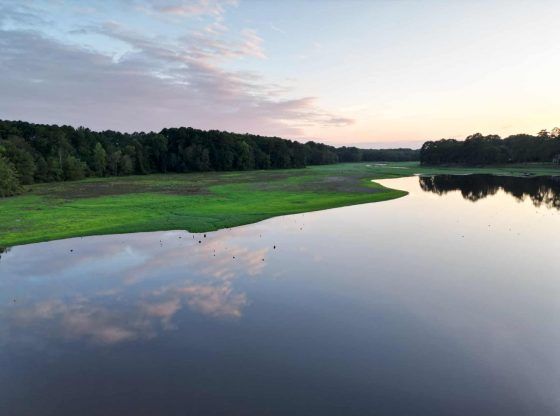
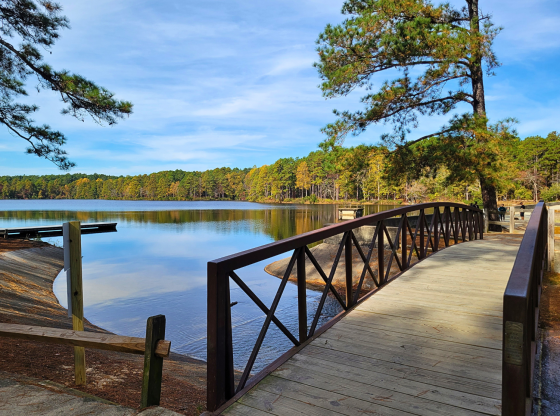
One of the board’s top priorities is the Crystal Lake dam and roadway, which were heavily damaged by Tropical Storm Chantal in 2025. The damage drained the lake and forced the closure of Camp Easter Road, a connector road that carries an estimated 2,000 to 2,500 vehicles daily, according to Matt Kitchen, a DOT representative who attended the meeting.
However, the project has hit a fairly complicated issue: DOT cannot fix the road until the dam is repaired, and the county does not own the dam. The county itself has no legal authority to repair or fund dam work, which limits its ability to intervene.
Vest said they are seeking legislative authority to help fund short-term emergency repairs, estimated at $240,000 to $250,000, since counties are not authorized to own dams or repair state-maintained roads. Longer-term restoration of the dam and spillway, projected to cost about $5 million, is being sought separately through FEMA by Crystal Lake Support, a nonprofit group.
McInnis raised the possibility of using NCDOT contingency funds, but Kitchen confirmed that, for the most part, the funds cannot be used until the dam is structurally restored, because DOT only maintains the roadway surface, not the underlying dam structure.
The goal is to reopen Camp Easter Road as soon as possible while long‑term FEMA funding is pursued. Its closure has doubled emergency response times, which officials stressed is unacceptable for public safety. A draft bill has been shared with McInnis, with options for a sunset clause or limits on county involvement.
Should the lake be restored, the county is considering the possibility of using a repaired Crystal Lake as a future public water source, noting that Southern Pines remains an alternative but that long‑term ownership and control of water assets are priorities for the board.
Engineers estimate the lake could function as an 80‑million‑gallon reservoir capable of producing about 2 million gallons per day, with the potential to expand to 5.5 million gallons per day at a much higher cost.
McInnis urged the board to “1-up” the planning by considering a 5.5-million-gallon capacity to stay ahead of the county’s rapid growth, even though it’s a more costly option.
“It might behoove us to go ahead and build it,” said McInnis. “Water demand is never going to go down. Let’s look beyond us, if you will, because, as I say about our county to a lot of people, our secret has been found out. We have a lot of people coming here. We have something everyone wants, so we need to make sure we take care of it. If we have a chance to 1-up someone and get in front of it, let’s do it.”
The county has requested a 10% design study—with applications closing Jan. 27—to analyze hydrology, depth, pumping needs, and potential plant locations, with a detailed report expected in six months.
School Funding and Uncollected Gambling Taxes
The session concluded with a discussion on the rising costs of education. Picerno noted that local tax dollars are increasingly used for “enhancements” such as band and orchestra teachers rather than for maintaining aging school buildings.
He said this leaves fewer resources for basic facility maintenance, contributing to school buildings falling into disrepair and forcing the county to consider expensive bond referendums for new construction. Picerno suggested that if the state provided dedicated funding for enhancement programs, counties could redirect local dollars toward upkeep and extend the life of existing schools.
McInnis, who is also the senior chair of Senate Finance, pointed to uncollected taxes on sports gambling and the lottery as a potential source of relief. He revealed that despite a reported $9.5 billion in sports gambling activity, only $4 million generated tax documents.
“We’re losing about a million dollars a day and don’t go back and cross-reference or audit these gambling organizations,” McInnis stated, pledging to investigate how these funds can be better directed toward North Carolina schools. He characterized this as “low‑hanging fruit” that could help fund schools if properly collected.
Before Departing
During the meeting, Picerno thanked McInnis for taking the time to not only meet with the board but also to hear the county’s problems and proposals alike.
“We’ve never had a senator or a House of Representatives member in the state house that’s been so good for the people of Moore County,” said Picerno. “You’ve been so responsive, you’ve been easy to get ahold of, you’ve tried to help us. That is something I’ve not experienced in my decade as a commissioner.”
McInnis closed by praising the county’s low tax rate, attributing it to strong local leadership and a healthy golf economy.
Abegail Murphy | Assistant Editor
Article and photo by Sandhills Sentinel Assistant Editor Abegail Murphy. Abegail has been writing for Sandhills Sentinel since 2021.
Want Moore news that matters? Please click here to sign up for the free Sandhills Sentinel e-newsletter.
Follow Sandhills Sentinel: Facebook | X | Instagram | YouTube | TikTok | Threads | Newsletter