

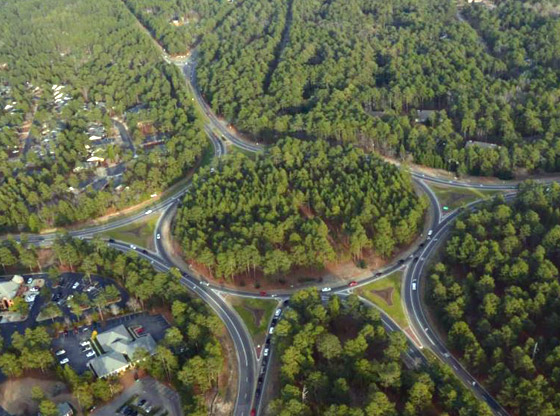
At a recent meeting, the Pinehurst Village Council unanimously approved a resolution opposing the North Carolina Department of Transportation’s latest proposal to redesign the historic Pinehurst Traffic Circle. Instead, the board is urging that the state pursue incremental, data-driven improvements that preserve the landmark’s character.
Resolution 26-12, adopted Feb. 24, “formally rejects” NCDOT’s current plan for the 70-year-old circle and calls on the agency to revisit traffic projections and consider alternative designs that maintain the circle’s safety, aesthetics, and efficiency.
“We’ve been down this road in the past,” Mayor Patrick Pizzella said during the meeting. “The circle is located in our National Historic District, and it has been the iconic gateway to our village for 70 years.”
The NCDOT’s earlier “Shifted Pillow Continuous Flow Intersection” proposal was withdrawn in 2024 following public opposition and a unanimous council vote against it. In 2025, the agency introduced a revised design that could require the use of eminent domain, potentially affecting properties in nearby neighborhoods.
Council members cited concerns about property rights, safety, and the village’s historic character.
The current proposal would not begin construction until 2031 and would take two years to complete, with a projected cost of $77 million. Pizzella noted the project was originally estimated at $54 million.
“We’ve got some time to work on this,” he said.
A key factor in the council’s decision was updated population data from the North Carolina Office of State Budget and Management, which produces official state and county projections. The latest forecast estimates Moore County’s population at 141,000 by 2050, which is a 21.7% decrease from a 2023 projection of 180,000.
Mayor Pro Tem John Taylor said those revised numbers call into question NCDOT’s projection that traffic through the circle will increase from 50,000 vehicles per day to 80,000 by 2050.
“Their original premise was that 50,000 in 2023 was going to become 80,000 by 2050,” Taylor said. “You don’t need to have studied math in college — you can figure out that that’s one and three-quarter percent compound annual increase.”
Taylor argued that projected growth rates for Moore County and surrounding counties do not support that level of traffic growth. “If you’ve got 1% for Moore County and less than half a percent for all the other counties around Moore County, I don’t know how you get to 1¾%,” he said.
Council members stated that they are not advocating for inaction. Instead, the resolution encourages NCDOT to implement smaller-scale changes, such as enhanced signage, rumble strips, improved sightlines, and speed adjustments, many of which were referenced in previous correspondence between the village and the state.
“I don’t believe doing nothing is either the right thing to do or a pragmatic thing to do,” Taylor said. “I do think some of the other things that they have studied … there are absolutely improvements that can be made which go very far short of what has been proposed so far.”
Safety statistics also factored into the council’s decision. According to NCDOT data cited in the resolution, roundabouts constructed across North Carolina reduced total crashes by 46% and fatal and injury crashes by 76% in a previous study. The resolution notes that the Pinehurst Traffic Circle has not experienced a traffic fatality in its 70-year history.
After accidents peaked at 122 in 2021-2022, council members said the number declined to 77 and 78 in the past two years following the installation of lane dividers and clearer signage.
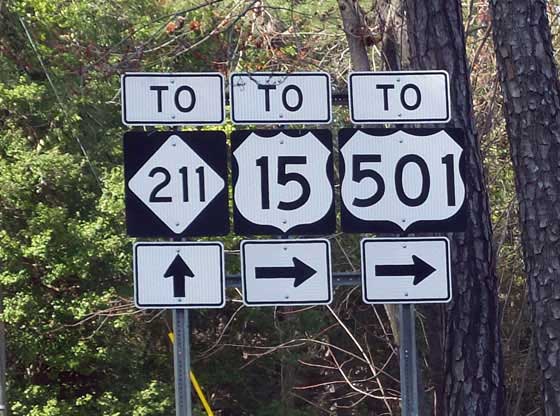
The resolution calls on NCDOT to reexamine projected 2050 traffic volumes in light of the updated demographic data and to review alternative designs documented in a 2023 traffic analysis. It also encourages the state to move forward sooner with widening U.S. 15-501 north of the circle and to consider adding a smaller circle at the Airport Road and Midland Road intersection.
Pizzella said the council will forward the resolution to members of the General Assembly, the governor, lieutenant governor, attorney general, secretary of transportation, the North Carolina State Historic Preservation Office, and the Sandhills Metropolitan Planning Organization.
“For some people it’s about safety, for some people it’s about aesthetics,” Pizzella said. “But for a lot of people, it does deal with the tradition, the ambience about this community. And I think that’s something that we as elected officials ought to be factoring in when we make decisions—significant, major decisions that would impact our village.”
Feature photo via the Village of Pinehurst.
Abegail Murphy | Assistant Editor
Written by Sandhills Sentinel assistant editor Abegail Murphy. Abegail has been writing for Sandhills Sentinel since 2021.
Want Moore news that matters? Please click here to sign up for the free Sandhills Sentinel e-newsletter.
Follow Sandhills Sentinel: Facebook | X | Instagram | YouTube | TikTok | Threads | Newsletter








Comments
Comments are closed.