
The Southern Pines Historic Preservation Commission met on Feb. 12 to hold an informal discussion about a proposed mixed-use development in downtown. The proposed plan calls to demolish the Doug’s Auto building at the corner of Connecticut Avenue and Northwest Broad Street and replace it with retail shops and townhomes.
The board, however, agreed to delay a vote until March, when more councilmembers would be present, and opted to instead hold an informal discussion with the applicant.
The parcel sits just beyond the boundary recognized by the National Register of Historic Places, yet it falls within the town’s locally designated historic district. As a result, the Historic Preservation Commission has authority over the proposal.
Town documents state that the existing buildings do not contribute to the district’s historical significance. Before beginning demolition or construction, the applicant is seeking a Certificate of Appropriateness for major work, as new construction will need to comply and be deemed appropriate.
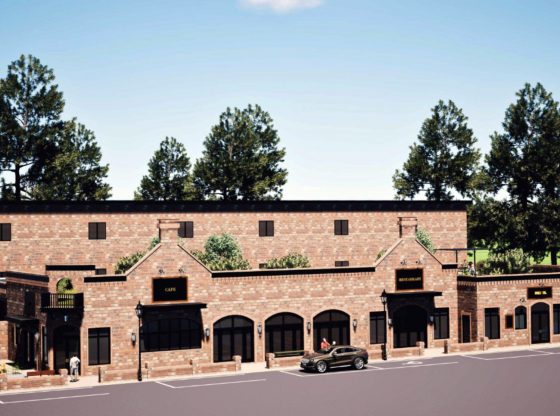
The proposal calls for demolishing the current structure and constructing a one-story commercial building with four tenant spaces facing Broad Street, along with eight to nine townhomes behind it, accessed from Connecticut Avenue.
Current plans show two restaurant spaces, one retail space, and one beauty salon totaling about 9,826 square feet, plus roughly 2,600 square feet of patio space. The townhomes would range from 2,000 to 4,000 square feet and include two-car garages. A rooftop green space is also under consideration for townhome residents.
Plans also call for roughly eight parallel parking spaces along Northwest Broad Street and about eight angled spaces off West Connecticut Avenue. The on-street spaces along Broad would require approval from the North Carolina Department of Transportation because the roadway is state-maintained. The developer has suggested narrowing or shifting travel lanes and relocating the sidewalk onto the site to make room for the additional parking.
Because the site falls within the downtown overlay district, no off-street parking is required under current rules. The applicant is requesting a parking waiver recommendation from the commission to maintain what he described as a traditional downtown appearance.
When asked about stormwater management, a growing concern in areas with increasing amounts of paved surface, Developer Andy Bleggi said the project proposes pervious pavers in place of a retention pond.
The development would use brick similar in color and pattern to other downtown buildings, including references to the nearby railroad depot and ice cream parlor. All street-facing sides would be brick, with black or bronze metal awnings, copper accents and screened rooftop mechanical equipment. The commercial building would rise one story along Broad Street, with townhomes stepping up to three levels along Connecticut due to grade changes. Maximum height would remain at or below the 45-foot limit.
Bleggi told the commission that the lot is a gateway to downtown, and he’d like to build an appropriately designed building that does the district justice.

Bleggi shares design plans.
“We understand it’s a very important piece of property, that’s why we bought it, and we like it,” Bleggi said. After an accusation that Bleggi is only trying to further his brand, Bleggi added, “I’m not trying to advance my brand. I’m trying to fit into the historic district with a design people like. I’m not trying to recreate the wheel.”
Bleggi said historic-style buildings tend to attract tenants more readily than modern designs and noted there is already a waitlist for the commercial spaces.
Planner BJ Grieve, however, questioned that assertion and said demand is tied more to the district’s established character than to the proposed architecture or efforts of the developer.
Grieve and commission member Robert Anderson also criticized elements of the design, including window placement and “arrangement of the architecture.”
“It’s the skill of your designer. They need to step up,” said Anderson, who pushed for a redesign and spoke at length of his dislike of the current plans.
Grieve reminded the applicant that the burden of proof rests with the developer. “You must bear the burden of proof that it adheres to the criteria set forth by the UDO for the historic overlay,” he said. “That subjectivity is why it’s a hearing.”
Bleggi’s team agreed to revisit the renderings, which they assured were not entirely to scale, to produce a more accurate concept and show more angles of the property.
Additionally, Blegi intends to amend his plans to temporarily remove the townhomes from his proposal and revisit them at a later time, allowing his team to focus their time and energy on first refining the retail spaces.
Render via PTAH, LLC.
Abegail Murphy | Assistant Editor
Article and meeting photo by Sandhills Sentinel assistant editor Abegail Murphy. Abegail has been writing for Sandhills Sentinel since 2021.
Want Moore news that matters? Please click here to sign up for the free Sandhills Sentinel e-newsletter.
Follow Sandhills Sentinel: Facebook | X | Instagram | YouTube | TikTok | Threads | Newsletter