
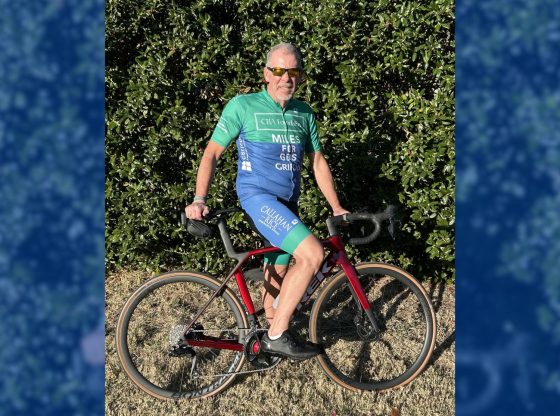
At 63 years old, Miles Washburn has never shied away from a challenge.
An athlete his entire life, Washburn is an accomplished cyclist who qualified for two U.S. regional teams and a golfer who competed on the amateur tour. Sports have always played an important role in his life, teaching discipline, resilience, and perseverance — qualities he would come to rely on in an entirely different way.
In January 2025, Washburn became sick with RSV, and what followed was a frightening and unexpected medical journey.
While at his house in Beech Mountain, clearing debris after a tree had fallen, Washburn noticed something unusual. He woke up with a “slight lisp.” At first, it seemed minor and something he thought could possibly be related to medication or the freezing mountain temperatures. But the symptoms didn’t resolve. He later found that he couldn’t spit, and warming up didn’t help.
With a growing sense that something wasn’t right, Washburn closed up his mountain house and returned to his home in Moore County. Over the next several hours, his condition worsened. He struggled to swallow, his speech became increasingly slurred, and he began experiencing profound weakness.
After a couple of attempts to medically treat what initially appeared to be a less serious condition, Washburn’s symptoms escalated rapidly. Recognizing the severity of what was happening, he and his wife, Cindy, sought urgent medical care.
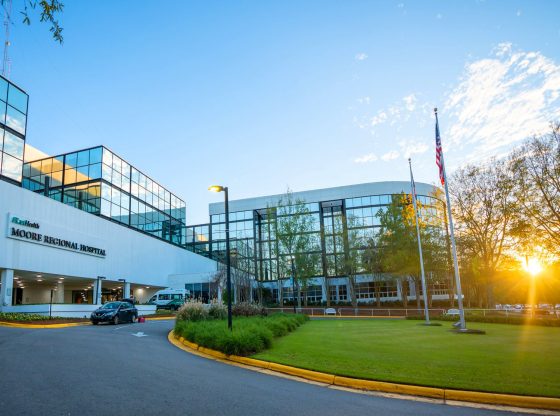
In the Moore Regional Hospital emergency department, the care team moved quickly to evaluate him, including ruling out a stroke. While imaging showed no evidence of stroke, it became clear that something serious was unfolding.
“The good news is you’re not having a stroke,” Washburn recalled emergency medicine physician Jonathan Brower, M.D., saying. “The bad news is that something is clearly wrong, and we’re going to figure it out.”
Dr. Brower began working through possible causes, including Guillain-Barré syndrome (GBS), a rare neurological condition Washburn had never heard of.
Washburn was admitted to the ICU, where additional testing began while his care team initiated treatment for several possible neurological conditions. During this time, Washburn lost his
reflexes, a key indicator of GBS, which neurohospitalist Steven Lewis, M.D., explained as part of the diagnostic process. A spinal tap soon confirmed the diagnosis of GBS.
With the cause identified, all other treatments were discontinued, and the team focused on treating GBS with IVIG therapy. Washburn quickly began to experience improvements in his condition. He spent five days in the ICU followed by a couple of days in a step-down unit, where he started physical therapy.
“Dr. Lewis explained to me that the disease took me down very fast, but I came back just as fast,” Washburn said. “He credited that to early diagnosis and my overall physical condition playing a significant role in recovery.”
Guillain-Barré syndrome affects roughly 1 to 2 people per 100,000 each year.
“Because most people will never encounter it personally, there is very little public awareness,” Dr. Lewis said. “It doesn’t have the cultural footprint of conditions like stroke or heart attack, even though it can be just as life-altering. That’s part of what makes cases like Miles’ so important to share.”
GBS is considered a post-infectious immune-mediated condition, meaning it can occur after the body fights off a viral illness.
“When the body mounts an immune response to a virus like RSV, it can occasionally misfire and attack the peripheral nerves outside the brain and spinal cord,” Dr. Lewis explained. “We don’t fully understand why this happens in some individuals and not others, but the connection between a preceding illness and the onset of GBS symptoms is well established.”
Early recognition of symptoms can be critical.
“GBS can progress from mild weakness to respiratory failure in a matter of days,” Dr. Lewis said. “The earlier we identify what’s happening, the sooner we can initiate treatment and improve the chances of a meaningful recovery.”
For Washburn, the experience was terrifying but also deeply meaningful.
“The care team made one of the scariest moments of my life as good as it could be,” he said. “I’m incredibly grateful for every person who cared for me.”
When Washburn left the hospital, he realized just how little he knew about Guillain-Barré syndrome. As he learned more, he felt compelled to turn his experience into purpose.
This summer, Washburn will take on one of cycling’s most iconic and demanding climbs, Mont Ventoux in France, to raise awareness and funds for the GBS Foundation’s patient assistance fund.
Throughout his illness and recovery, Washburn and his wife felt extremely blessed. He was able to access the equipment, medications and therapies he needed to support his recovery, which included a cane and ongoing treatment when necessary. He knows not everyone has that same access.
“Those things make a real difference,” Washburn said. “I want to help make recovery a little easier for someone else.”
The idea for the climb took shape during a trip to France with his wife, his brother, and his sister-in-law. Sitting in view of Mont Ventoux, both his wife and brother suggested he should climb it. Washburn laughed it off — but the idea stayed with him.
After time in reflection and prayer, he felt called to move forward and use the climb to raise awareness about GBS and to support others navigating similar journeys.
By August 2025, Washburn began training and partnering with the GBS Foundation, which provides direct support to patients and families and never turns anyone away. All donations go directly toward patient assistance.
Washburn is covering all of his own travel and equipment expenses. Every contribution raised through his climb will go directly to the GBS Foundation to support patients recovering from GBS.
“The mountain is just a symbol,” Washburn said. “We all have mountains to climb in our lives. Through this, I hope to encourage others not to give up, to keep climbing and to help support those living with GBS.”
While Washburn continues to recover, he notes that GBS doesn’t simply disappear. He lives with what he calls a “GBS hangover” that includes lingering fatigue, nerve pain, occasional speech difficulties and the anxiety that comes with fear of getting sick again.
Through it all, Washburn says his greatest source of strength has been his wife.
“I’m grateful for my care team,” he said. “But I’m most grateful for Cindy. I couldn’t have done any of this without her.”
To learn more about Guillain-Barré syndrome or to support Miles Washburn’s fundraising efforts, visit www.gbs-cidp.org or search “Miles for GBS” on Facebook.
Want Moore news that matters? Please click here to sign up for the free Sandhills Sentinel e-newsletter.
Contributed article and photo.